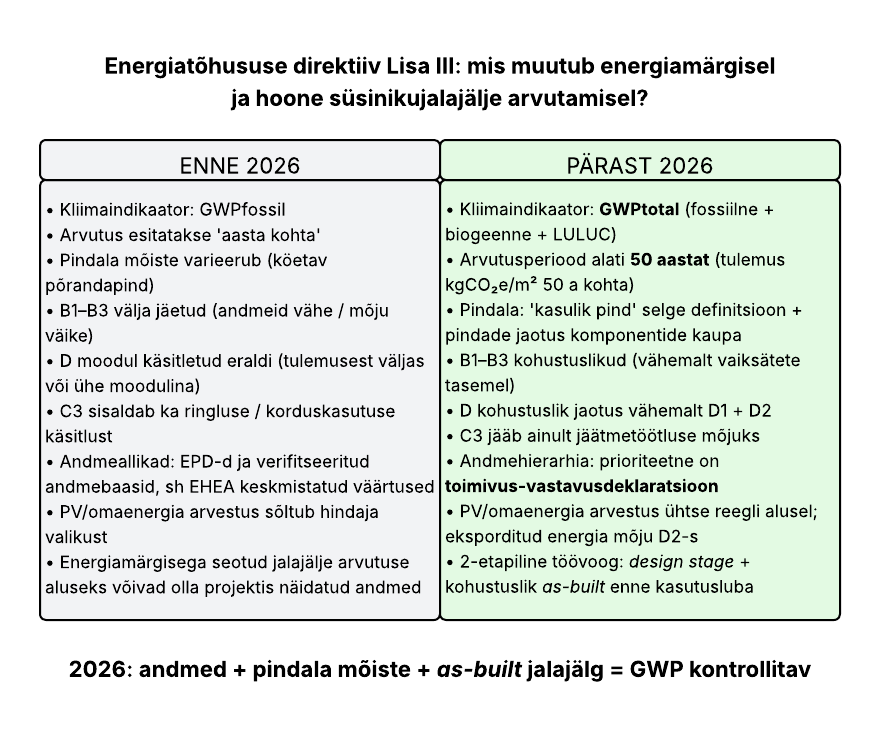
Annex III of the Energy Performance of Buildings Directive is being replaced by Delegated Act 8723 of 16 December 2025, Amending Annex III to Directive (EU) 2024/1275 of the European Parliament and of the Council as regards the Union framework for the national calculation of life-cycle global warming potential, establishing a new Annex III.
What does this mean for Estonia?
- Since the assessment of GWP for new buildings will henceforth proceed on a basis comparable across the EU, the methodology for assessing a building’s carbon footprint (BuildEST, EHEA, SARV) must be reviewed.
- Strong pressure will emerge to use low-carbon construction materials (such as low-emission cement and steel) and to support carbon sequestration technologies (such as timber structures, reuse, and recycling).
What are the substance of the changes?
1. The national building carbon footprint calculation methodology will require the mandatory declaration of emissions in the following additional stages as well:
B1 — Use = emissions volatile from materials/carbonisation and refrigerants, at minimum at the level of default values
B2 — Maintenance = may be simplified to the level of default values
B3 — Repair = may be simplified to the level of default values
D1 — Additional information beyond the system boundary = potential for reuse/recycling/energy recovery beyond the system boundary
D2 — Additional information beyond the system boundary = emission load/benefit from self-generated electricity/heat/water beyond the system boundary
Currently, B1, B2, and B3 are excluded from the building carbon footprint calculation on the grounds that data is lacking and the impact is small. Module D (biogenic carbon) is treated as a single module that is not included in the result. Both of these approaches are changing — categories B1, B2, B3, and D are all becoming mandatory, with D required to be reported at minimum as D1 + D2.
2. The national building carbon footprint calculation methodology is changing with respect to stage C3 Waste Processing, such that only the impact of waste processing remains in stage C3, while D1 reports separately the benefit/emission load beyond the system boundary.
3. Estonia’s energy performance certificate form must be revised so that:
- all mandatory modules are included, meaning the certificate must contain at minimum:
- A1–A3 — as currently
- A4–A5 — as currently
- B1–B4 — currently only B4 is included
- B6 — as currently
- C1–C4 — as currently
- D1
- D2
- the climate indicator, currently GWPfossil, must be replaced with GWPtotal;
- the EHEA database must support GWPtotal calculation (the sum of GWPfossil + GWPbiogenic + GWPLULUC).
4. Regarding usable floor area, a definition of usable floor area is being added and the report must present floor area broken down by component. This is necessary so that the indicator GWP kg CO2 eq/m2 is comparable across different buildings. When “usable floor area” = X m2 is stated, it must be clear whether only the area inside the building envelope is counted, and how stairwells, corridors, utility rooms, storage spaces, parking, basements, balconies, and similar areas are treated. The energy performance certificate unit “heated floor area” is replaced by “useful floor area” (useful floor area), so that the area in use is clearly described. Estonia’s building carbon footprint calculation methodology must stipulate that external areas and outbuildings are generally excluded, but that external technical systems within the owner’s responsibility and related to the energy performance certificate may be included without increasing the floor area.
5. The annual-basis approach is being revised, as the energy performance certificate requires an indicator of kgCO2eq/m2 usable floor area over 50 years (currently expressed “per year”). The reference period for building carbon footprint calculation must always be 50 years (currently the methodology states “proportional or at most 50 years”), and the indicator must be kgCO2/m2 (currently kgCO2/m2/year and kgCO2/m2/person/year).
6. The data hierarchy is changing, and accordingly the building carbon footprint assessment methodology must also move away from using averaged EPD values. The current methodology is based on the existing Annex III of the Energy Performance of Buildings Directive and permits, where possible, the use of data derived from the old Construction Products Regulation (CPR/305/2011). The new Annex III of the Energy Performance Directive, however, establishes a new data hierarchy as follows:
- performance-conformity declaration data takes priority;
- during the transition period, the use of energy performance certificate data from the old ecodesign regulation is permitted;
- project- and product-specific data may also be used (EN 15804, EN 50693, sector averages, generic data, and default values).
The current Estonian building carbon footprint assessment methodology permits the use of data from EHEA, EPDs, and other verified databases. Estonia must, however, transpose into its legislation the requirement that performance-conformity declarations compliant with the new Construction Products Regulation are always the primary data source. The current methodology has concluded that Estonia does not need an EPD registry since EPD data can be obtained from international registries. This assessment is now superseded by a requirement to organise data availability and quality hierarchy (whether or not via a registry). This also means that EHEA must become a regularly updated database operating according to defined rules.
7. A uniform rule is being established for on-site energy generation from solar panels or other sources at the building, specifying how the “construction footprint” of the system and the impact of the energy produced/exported are accounted for. Rather than being left to the assessor’s discretion, the Estonian legislator must define how the embodied CO2 emissions from the production and installation of the panels (i.e. choosing either approach A or B1/B2) and the impacts of exported energy (D2) are to be shown on the energy performance certificate. For simplicity, approach A is selected (i.e. the entire “footprint” of the renewable energy system — panels, inverter, installation, etc. — is assigned to the building, and exported electricity is reported separately in D2). For large buildings with high export volumes, approach B1 is selected (i.e. the footprint of the renewable energy system is apportioned — the share consumed by the building is assigned to the building, and the share of output that is exported is assigned to D2).
8. The energy performance certificate reflects the carbon footprint of the building as actually constructed. Accordingly, a two-stage workflow is being introduced:
- an assessment at the architectural and design stage (design stage);
- a mandatory update to reflect the building as actually built, to be completed before the occupancy permit is issued — this figure appears on the energy performance certificate.
What is the timeline for these changes?
December 2025 — delegated act published in the EU Official Journal, enters into force at the start of 2026
29 May 2026 — transposition of the amended Annex III must be completed in Estonia
1 January 2027 — Estonia’s roadmap for setting limit values must be finalised
1 January 2028 — GWPtotal must be disclosed on the energy performance certificates of all new buildings with a usable floor area exceeding 1,000 m2
1 January 2030 — GWPtotal must be disclosed on the energy performance certificates of all new buildings