
Managing the transition to a circular economy requires measuring circularity, and this must be done using indicators agreed upon internationally through circular economy standards. Only in this way is it possible to account for resource use impacts when assessing environmental aspects. Unfortunately, in Estonia it is not possible to use the indicators offered by circular economy standards, because we are bound by the Waste Act. That Act, however, only regulates waste recovery operations, whereas the circular economy focuses on the outcomes of those operations — namely, the secondary materials market.
All concepts necessary for understanding the circular economy are defined in the standard EVS-ISO 59004:2025 Circular economy. Vocabulary, principles and guidance, and further elaborated in other standards of the circular economy family. When defending my master’s thesis in industrial ecology in the spring of 2025, the assessment committee and the reviewer repeatedly remarked that the circular economy discourse was a highly confusing subject. I therefore compiled an overview, based on circular economy standards, of the core concepts underpinning the circular economy narrative.
The core principles of the circular economy are: systems thinking, value creation, value sharing, resource management, resource traceability, and ecosystem resilience.
A resource is a material asset used to create a solution — i.e. a product, service, or combination thereof — that meets the needs of a stakeholder. A resource may be a raw material, feedstock, material, or component. As an asset, a resource may be a physical resource (natural resources and primary resources), a renewable resource, or a secondary (used) resource. A resource may also be the energy content of a material, a stock, or a flow. In the context of the circular economy, the term resource is used in the context of business models, meaning that people — for example, suppliers — may also constitute resources in relation to a business model.
An economic system is a system by which society regulates the use of resources. Economic systems differ according to geographic region or jurisdiction and may include regulations on the use of resources and the production, utilisation, and disposal of those resources.
An environmental system consists of interacting natural systems encompassing both biotic and abiotic components. The environmental system comprises, in particular, the atmosphere, biosphere, hydrosphere, cryosphere, pedosphere, and lithosphere.
A social system is a system through which individuals are expected to perform certain actions in order to achieve shared societal goals.
A system in focus is defined by the boundaries of a selected system and constitutes the basis for measuring and assessing circularity.
Resource circulation is the systematic cycling of resource use through multiple technical or biological cycles.
Circular means being in alignment with circular economy principles, and degree of circularity refers to the extent of conformance with those principles.
A circularity aspect is that part of an organisation’s activities or solutions that relates to the circular economy, and a circularity indicator is a metric used to measure one or more circularity aspects.
Circularity aspects (such as product durability, maintainability, reusability, repairability, etc.) are, within a lifecycle perspective, that selection of activities through which the solution offered can exert the greatest environmental, social, and economic impact. Different companies or organisations have different options when selecting circularity aspects — for example, a company with high outsourcing needs has the greatest leverage in its upstream supply chain.
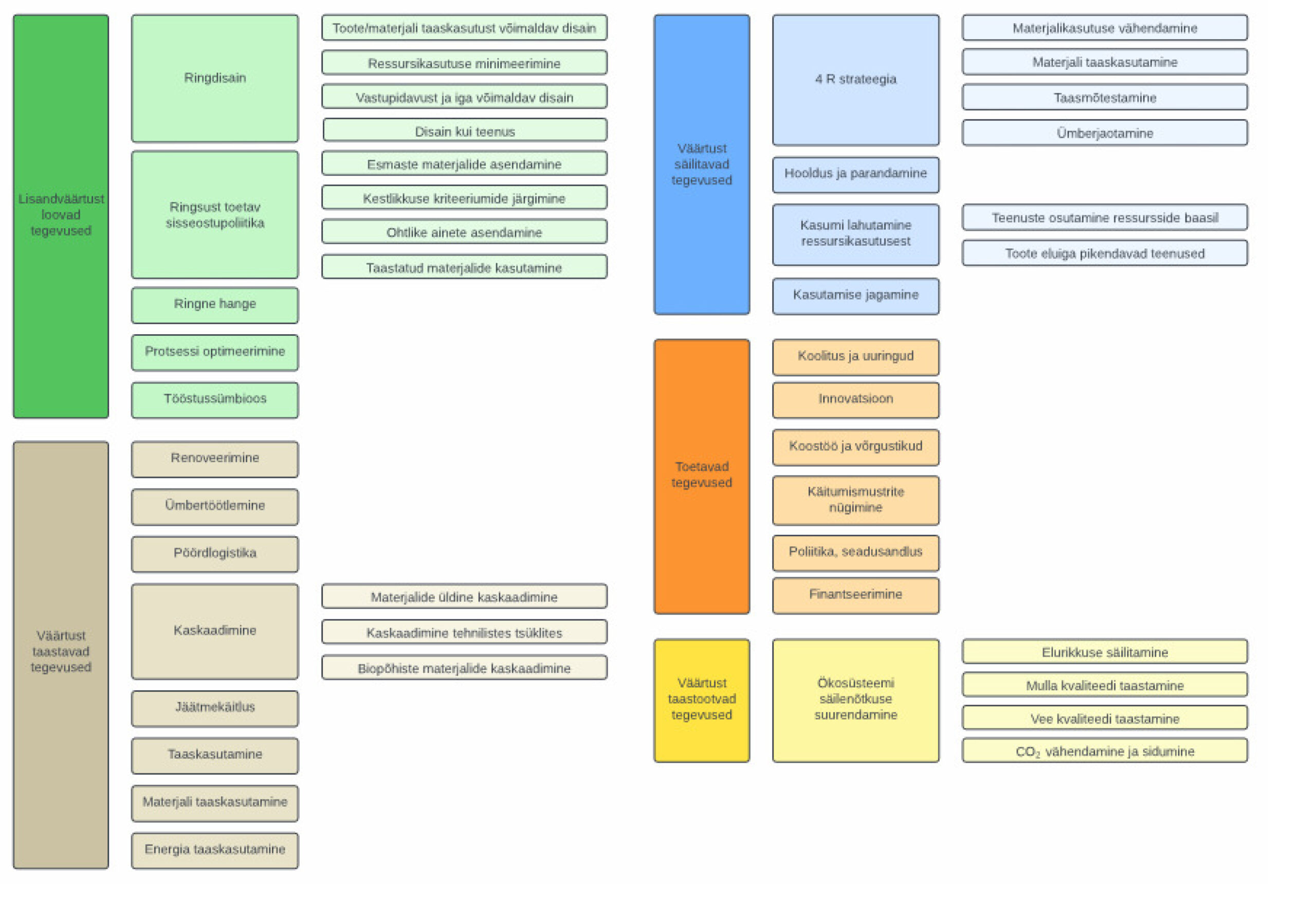
As activities supporting the achievement of circularity, standard ISO 59010 identifies five activity groups: value-adding, value-preserving, value-restoring, value-reproducing, and transition-supporting activities. I have visualised the circularity-supporting activities presented in ISO 59010 in the figure below:
Recycling refers to activities that produce recovered resources (noun) for use in processes or products. Recycling may involve mechanical, physical, chemical, and biological processes or combinations thereof.
When evaluating a recycling process, it is important to assess whether the quality of the resource is maintained during the process (i.e. whether the resource can be used for the same purpose) or diminished. In the Estonian conceptual framework, recycling is interpreted in accordance with waste management regulations — that is, as a waste recovery operation with no connection to the quality of the resource obtained as a result of the process. This significantly impedes the application of circular economy principles in Estonia, because implementing circularity requires measuring the mass of recycled material.
Reuse refers to the use of a product or its parts after original use, but for the same purpose as the original. In the Estonian conceptual framework, reuse is interpreted in accordance with waste management regulations — that is, as a recovery operation by which products or their components that have become waste are prepared for reuse without pre-treatment. This significantly impedes the application of circular economy principles in Estonia, because implementing circularity requires measuring the mass of reused material.
Recovery is a general term referring to the return of recoverable resources to active use. Recovery preserves or enhances the value of resources and may be carried out through various methods, such as reuse, refurbishment, remanufacturing, recycling, etc. A distinction is made between material recovery and energy recovery.
Material recovery is the return of recoverable resources to active use.
Energy recovery is the treatment of resources at the end of their useful life, once their recyclability has been exhausted, for the purpose of generating energy or heat. In the Estonian conceptual framework, recovery is interpreted in accordance with waste management regulations, and consequently the energy use of resources is not counted as recovery. This significantly impedes the application of circular economy principles in Estonia, because implementing circularity requires measuring the share of recovered energy — i.e. energy derived from municipal, non-renewable, and non-recoverable resources — in the outflow.
Strategies for transforming a linear business model into a circular one may vary, but the circular economy standard identifies, for example: the gradual closure of linear value chain cycles until a value network has emerged; expansion of the complexity and scope of activities; priority-setting based on the double materiality matrix; shifting the revenue/cost break-even point; reverse logistics; and industrial symbiosis.
References are available here: Anu Kull TalTech thesis: quantification of circularity
When citing this text, please include the reference: A. Kull, Circular Village: a circular economy business model in real estate development. Tallinn University of Technology, 2025.