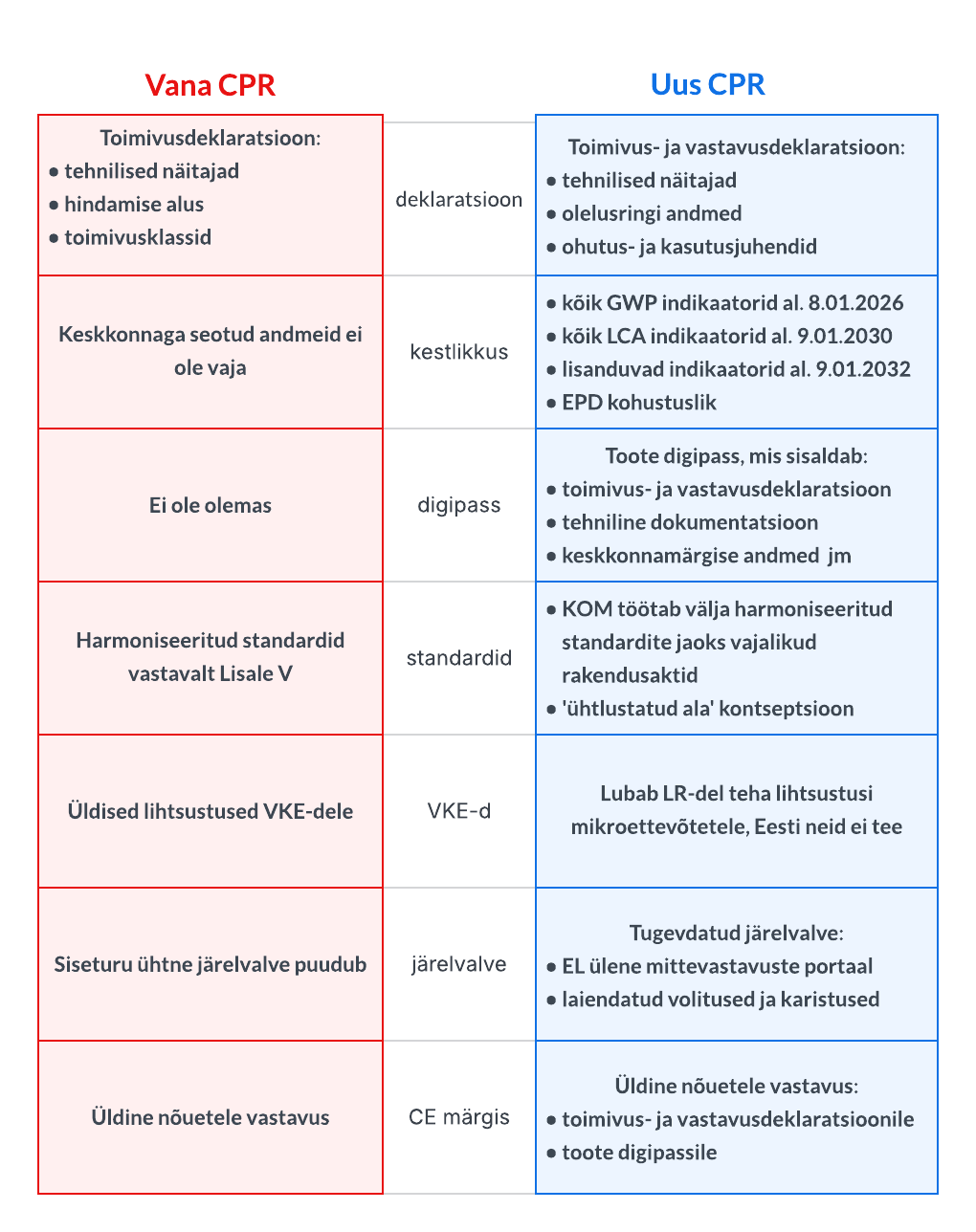
On 22 August 2025, amendments to Estonia’s regulation on Requirements for Building Materials and Products and the Procedure for Demonstrating Conformity with Those Requirements (Regulation No. 49 of 26 July 2013) entered into force. These amendments arise from the need to transpose the new EU Construction Products Regulation, which entered into force on 7 January 2025. Based on the explanatory notes accompanying the amendments, one might form the impression that the changes are purely terminological — for instance, the term “declaration of performance” is replaced by “declaration of performance and conformity,” and “instructions for use and installation” becomes “general product information, instructions for use, and safety information.” The impact assessment likewise confirms that the amendments have no effect on social development, security, or external relations, nor any financial implications — neither additional costs nor additional revenues. It sounds routine and safe. But is that the full picture?
What actually changes?
On the surface, one might conclude that nothing substantive is changing. However, a more thorough comparison with the Construction Products Regulation reveals considerably more significant changes that have so far received little explanation.
Since 2013, Estonia’s requirements for construction products have been based on seven classical essential characteristics:
- mechanical resistance and stability;
- fire safety;
- hygiene, health, and the environment;
- safety and accessibility in use;
- protection against noise;
- energy economy and heat retention;
- sustainable use of natural resources.
The new Construction Products Regulation adds a significant new direction: the climate resilience of buildings and their products. This means that the following new essential requirements are introduced:
- construction products must demonstrate a reduced environmental footprint over their entire lifecycle, including during demolition and disposal;
- the entire process of design, construction, use, and maintenance must follow circular economy principles.
What does this mean for businesses?
Where it was previously sufficient to demonstrate technical performance and obtain CE marking, there is now an obligation to also account for environmental impacts and circular economy principles. In practice, this means:
- preparing environmental product declarations (EPDs);
- applying circular economy standards (EVS-EN 59000 series);
- adopting digital product passports.
Why might this go unnoticed?
Estonia lacks a comprehensive legal framework for the circular economy, and the applicable legislation is the Waste Act, which does not cover the lifecycle impacts of buildings or the environmental impacts of products (not to be confused with the carbon footprint). It may therefore appear that amending the regulation does not introduce any substantive requirements. In reality, however, it sets new expectations for all those who manufacture, import, or use construction products — in other words, for all companies operating in the sector.
The takeaway?
Although the explanatory notes accompanying the revised version of Regulation No. 49 of 26 July 2013 suggest only formal updates, they conceal a significant paradigm shift. The construction products world is moving increasingly towards environmental sustainability, transparency, and the circular economy. Companies that begin early to use environmental product declarations, circular economy standards, and digital passports will gain a significant competitive advantage. The question is no longer whether change is coming, but whether we are ready to demonstrate our environmental sustainability credentials.
Consider the old (305/2011) versus the new (2024/3110) Construction Products Regulation and ask whether your company is prepared to demonstrate compliance with the new requirements.