During the 2021–2027 period, Estonian local governments and businesses have access to considerable subsidies to develop circular economy and industrial symbiosis solutions. Unfortunately, both the planning of support measures and the discussions around circular economy have overlooked the most fundamental question. If the stated objective is a transition to the circular economy, how do we measure the effectiveness of our actions? When six million euros from the structural funds are distributed to support the adoption of circular economy-based production and consumption models, how is the effectiveness of that support measured? When 25 million euros from the structural funds are allocated to increase recycling capacity, how is the effectiveness of that support measured? It should not be forgotten that the national budget allocates a total of 153 million euros under the circular economy expenditure line. But what appears on the revenue side? The silence is deafening, because in reality there is no measurement of whether this money actually supports circular economy development.
Why the circular economy is unavoidable
Acknowledging the need to transition from a linear economic model (take-make-waste) to a circular economy is the single most important shift that must be introduced into economic thinking. It is fair to say that the transition to a circular economy is the most important economic development trend of the coming centuries. In a context of dwindling resources and growing demand, there is simply no other way to survive. But merely distributing money is insufficient. If the objective is a transition to the circular economy, the effectiveness of activities must also be measured. Otherwise, there is a risk that we engage only in apparent success stories.
Foundations of circularity measurement
Progress in the circular economy is assessed using circularity indicators. In simple terms, these are metrics that show what share of the resource in use is circular — i.e. renewable, recovered, or processed — and what share is new, i.e. primary and non-renewable.
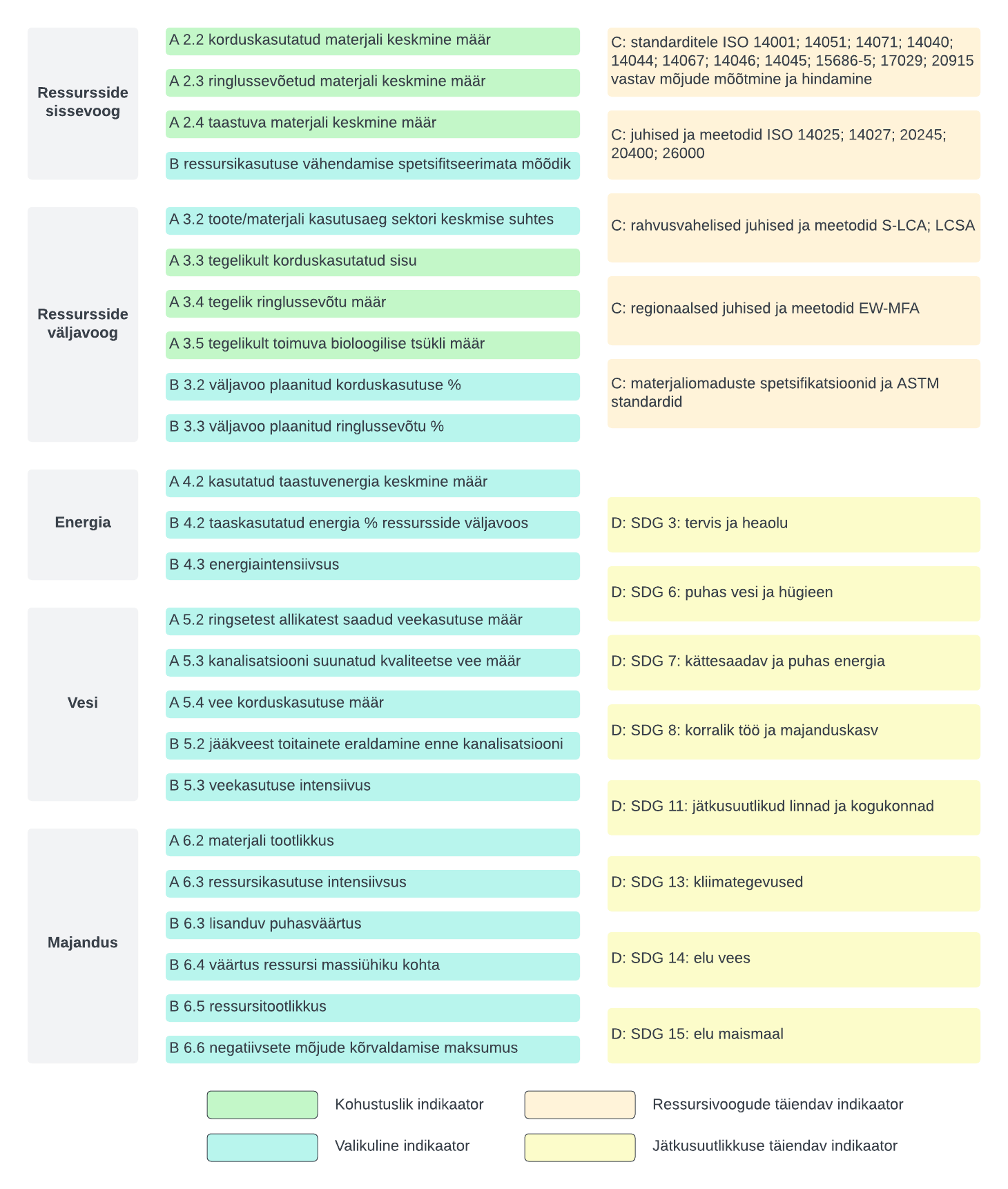
Circularity indicators are defined by circular economy standards and come in four types:
- mandatory indicators — 6 type-A metrics, without which one cannot claim to be engaged in the circular economy;
- optional indicators — additional metrics according to the project’s objectives (B-type and remaining A-type indicators);
- supplementary indicators for assessing the impact of resource flows (C-type indicators);
- supplementary indicators for assessing sustainability (D-type indicators).
Here is an overview of all circularity indicators. For detailed descriptions and calculation rules, refer to the circular economy standards.
The most important point to understand is: if the mandatory indicators are not used, then no real circular economy activity is taking place. It is that simple. Estonia’s circular economy support measures do not use any mandatory circularity indicators. Not a single support measure, in a combined total of 153 million euros, uses even one mandatory circularity input or output indicator.
The circularity formula is simpler than you might think
The circularity formula is straightforward: both the inflow and outflow of resources consist of circular and non-circular resources. The circular flow shows the share of renewable, processed, and recovered resources in the total mass. The primary flow shows the share of primary and non-renewable resources in the total mass. Because both the inflow and the outflow of resources must be measured, the mass of recycled, processed, and renewable content must be measured in both directions. Together, these form the 6 mandatory indicators on the basis of which one can objectively state whether the circularity of resources is increasing or not. The greater the share of circular content in the total mass, the higher the degree of circularity.
Who holds the key?
The selection of the remaining indicators depends directly on the objective that the specific circularity-supporting solution is intended to fulfil. This objective does not emerge from thin air — it derives from the circularity target set by the company itself. For example, one company may focus on increasing the reuse of raw materials, while another focuses on reducing production process residues or extending the lifespan of its products. This choice determines which supplementary and optional indicators it makes sense to use in order to accurately assess the impact of the solution.
It is important to understand that circular economy solutions can in practice only be created by resource owners — i.e. businesses that have the decision-making authority to determine which raw materials they use, what quality and durability their products have, and how the product lifecycle is managed. Local governments, the state, or support measures can facilitate and support the creation of these solutions, but the decisive impact must come from the company level.
Subsidies are like a starting pistol: they provide the energy and courage to begin. But if transparent and unambiguous measurement of results is absent, and if the mandatory circularity indicators are not used, then it may happen that the money is spent but the actual impact remains unclear. Without clear measurement, it is impossible to distinguish whether we have taken substantive steps towards a circular economy or are simply producing attractive projects on paper.
Summary: Public subsidies allocated for the circular economy represent a significant opportunity — but only if we measure the results using clear, mandatory indicators. Otherwise, it may happen that we talk about the circular economy while actually moving away from it.
References are available here: Anu Kull TalTech thesis: quantification of circularity
When citing this text, please include the reference: A. Kull, Circular Village: a circular economy business model in real estate development. Tallinn University of Technology, 2025.