
Against the backdrop of the EU’s green transition and the expanding scope of sustainability reporting requirements, small and medium-sized enterprises (SMEs) face a growing need to collect and present ESG data in a cost-effective and practical manner. The VSME standard (Voluntary Sustainability Reporting Standard for SMEs), developed by EFRAG, offers a simplified and voluntary framework designed specifically with SME needs in mind. The standard is grounded in internationally recognised sustainability reporting principles while being adapted to the resource constraints of smaller organisations.
Implementing it does not require creating new positions — it requires retraining existing accountants. Accountants already sit at the centre of a company’s financial data flows, have access to the necessary information, and understand their clients’ operations and data structures. This gives them a distinct advantage over external consultancies, which must first familiarise themselves with business processes before adding value.
Why accountants?
- Trusted partnership: Accountants are often the most stable and trusted advisers to SMEs.
- Data access: They already have access to financial data, to which ESG metrics can be added.
- Cost-effectiveness: There is no need to hire a dedicated ESG specialist — upskilling existing staff is sufficient.
Research findings and methodology
Ortiz et al. (2024)
- Sample: 37 European small and medium-sized accounting practices (SMPs).
- Methodology: Focus group methodology using an online questionnaire. The questionnaire included both quantitative (five-point Likert scale) and qualitative questions, based on EFRAG’s proposed non-financial reporting standards.
- Results: Accountants’ suitability as sustainability reporting preparers was rated at an average of 4.20/5, exceeding ratings for auditors (3.65/5) and tax advisers (3.48/5).
O’Reilly et al. (2024)
- Sample: 203 accountants and SME practitioners internationally.
- Methodology: Structured online survey based on an abbreviated environmental sustainability reporting framework developed by the authors, grounded in GRI environmental aspects and adapted for SMEs. Respondents rated the feasibility and benefit of each metric and identified obstacles.
- Results:
- 62% considered VSME metrics practically implementable.
- 18% found them too complex.
- 20% were unable to assess.
- 71% indicated a need for automated ESG data collection tools.
- 58% acknowledged having no prior experience in ESG data collection.
Vest (2025)
- Sample: 193 Estonian accounting firms; supplemented by an interview with a representative of the Ministry of Finance.
- Methodology: Quantitative survey on VSME awareness, interest, and readiness.
- Results:
- 26% are considering offering VSME services.
- 41% were unaware of the VSME standard.
- 73% of those would be willing to participate in a free online training.
- 91.2% had observed no client interest.
- Main barriers: lack of knowledge (36.8% of respondents), low awareness (only 10% well-informed).
The consultant’s role — not the doer, but the guide
The role of an external consultant should not be to prepare the report independently, but to:
- Engage directly with the company and work alongside the accountant.
- Map data sources — identifying where and how the necessary ESG data can be retrieved.
- Prepare the first report together with the accountant — learning by doing.
- Set up automated data systems so that the accountant can collect data on an ongoing basis and prepare reports independently thereafter.
This approach ensures that knowledge and capability remain within the organisation and reduces dependence on external service providers.
Barriers and solutions
- Vest (2025): Low awareness (10% well-informed), lack of knowledge (71 firms), absence of client demand (91.2%).
- Ortiz et al. (2024) and O’Reilly et al. (2024): The same bottlenecks appear internationally — insufficient ESG training, limited resources, low client demand.
- Solutions: targeted training, practical tools, increased stakeholder pressure, and adoption of IT solutions.
Comparison table
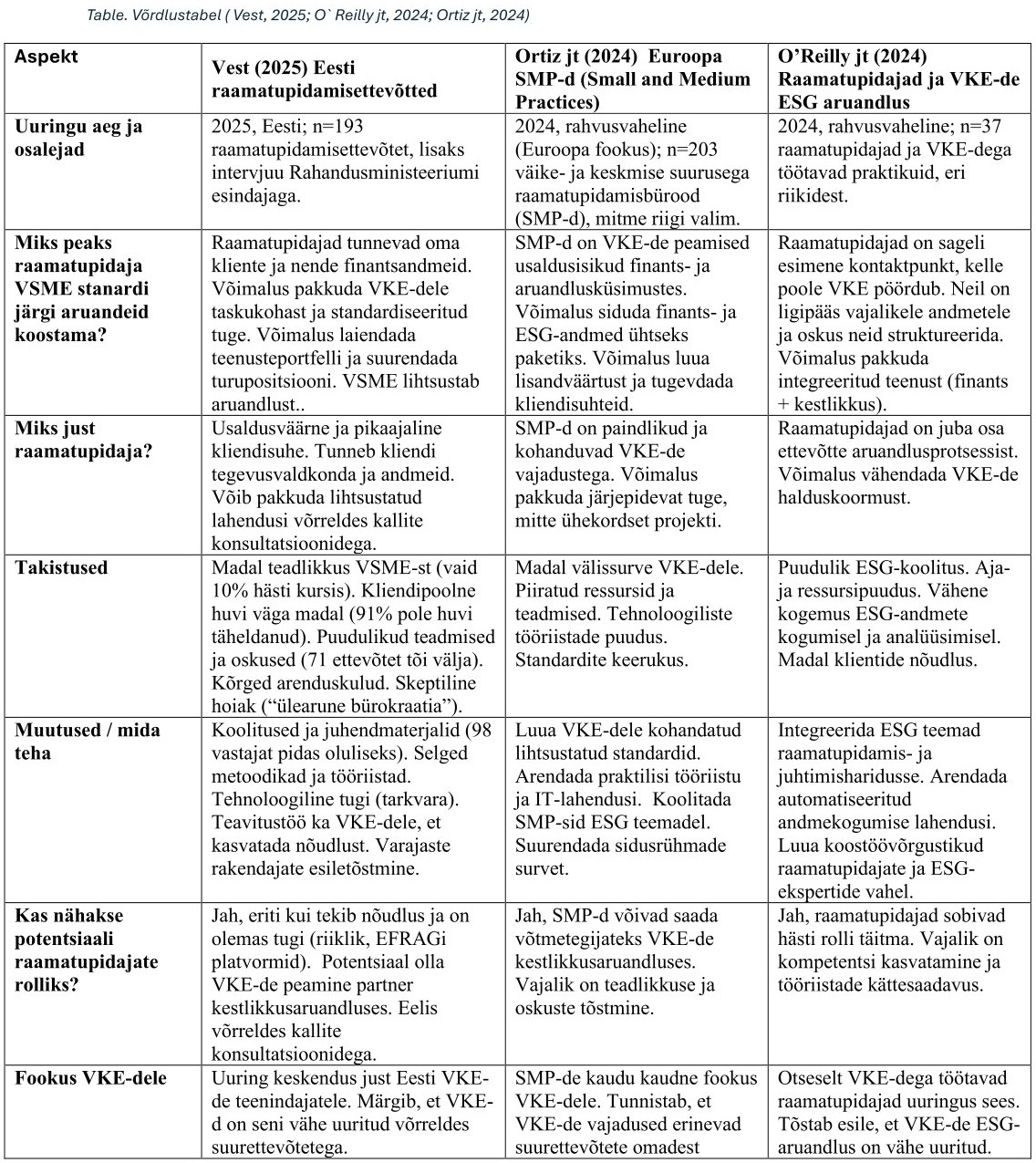
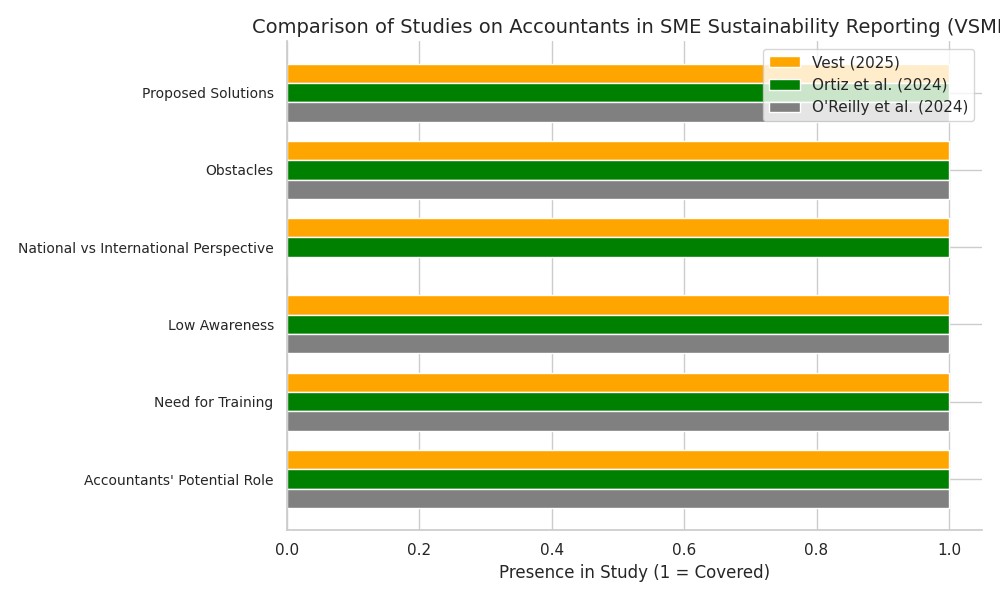
The findings across all three studies confirm that accountants are the logical and cost-effective choice for SME sustainability reporting. What is needed is targeted retraining, practical tools, and initial collaboration with an external consultant to establish a functional system. Once in place, accountants can independently and consistently meet the requirements of the VSME standard — without the company needing to create new roles or depend on costly external services.
- O’Reilly, S., Bhaird, C. M. A., Gorman, L., & Brennan, N. M. (2024). Accounting practitioners’ perspectives on small- and medium-sized enterprises’ environmental sustainability reporting. Journal of Applied Accounting Research, 26(6), 26–46. https://doi.org/10.1108/JAAR-08-2023-0250
- Ortiz, E., Marín, S., & Thompson, P. (2024). The role of small- and medium-sized practices in the sustainable transition of SMEs. Environment, Development and Sustainability, 26(8), 19299–19323. https://doi.org/10.1007/s10668-023-03507-3
- Vest, L. (2025). Eesti raamatupidamisettevõtete valmisolek ja vajadus VSME standardite rakendamiseks [Tallinn University of Technology].