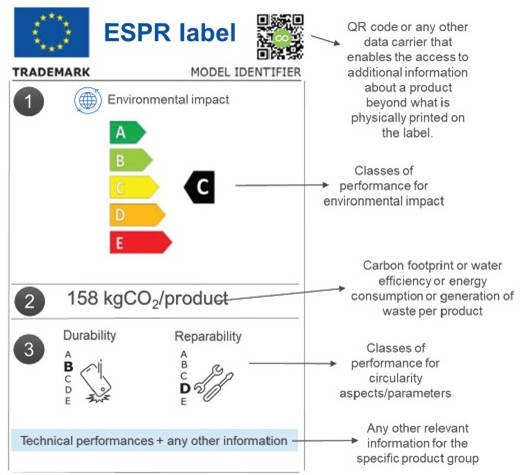
The Ecodesign for Sustainable Products Regulation (ESPR, Regulation 2024/1781) stipulates that the product digital passport will become mandatory on the EU single market (Chapter III), but additionally allows for the use of a uniform consumer label (Art. 16). Whereas under the now-repealed Ecodesign Directive this label was intended for energy-related products, the uniform consumer label framework may henceforth be used to inform consumers across all product groups covered by ESPR — in principle all products, with the exception of food, veterinary products, and pharmaceuticals. It should be noted here that ESPR only determines the design and presentation format of the label. The actual content to be displayed is generated only when a European Commission (EC) delegated act mandates it for a specific product group.
My intuition is that this primarily offers an opportunity for energy-related products to update the existing energy label to an ESPR-compliant label meeting the new requirements. Whether the uniform consumer label framework will be extended to other product groups remains to be seen. I am sceptical, since the product digital passport already contains the same information in considerably greater detail, and I cannot see why the market would want an additional label alongside the CE mark and the product digital passport — especially given the requirement that physical labels must include data carriers (e.g. a QR code or similar) providing access to the digital product passport. The correct answer will become clear soon enough — one simply needs to stay informed about the delegated acts issued by the Commission.
The energy label (A–G) has to date been one of the few regulatory tools that is widely recognised and used in practice — for building energy performance certificates, refrigerators, and similar products. Against this backdrop, the European Commission’s Joint Research Centre (JRC) published a report providing a methodology for defining performance classes that cover the substantially broader sustainability requirements imposed by ESPR — well beyond energy labelling (A–E) — and proposing a possible content for the future so-called ESPR label [1]. The starting point of the report is that the energy label works because the scale is simple (A is better than B); information is comparable within the same product group; design and presentation are standardised; and clear rules for product improvement have been established for manufacturers. The most informative section of the report concerns the definition of specific performance classes, because within the ESPR framework we are no longer operating in the world of energy labelling. The new objective is to develop a methodology that categorises products into 5 classes (A–E) in such a way that the classes represent meaningful differences in environmental performance. The approach draws on product environmental footprint (PEF) assessment in terms of both aggregate results (score) and individual impact categories. Class boundaries are set using a representative reference model approach, under which class C is the midpoint, and the best and worst products are anchored to its boundaries using sensitivity analysis where necessary.
The report proposes a four-step approach for deciding which parameters are suitable for performance classification:
- Assessing the relevance of circularity aspects;
- Collecting data on the characteristics of the product group;
- Calculating the suitability of parameters;
- Selectively assessing the potential for improvement.
The last three steps are unlikely to pose problems in an Estonian context. However, the first step — assessing circularity aspects — presents a challenge. Estonia continues to cling to the view that circular economy is based on the Waste Act, conscientious waste sorting, and local municipalities’ capacity to manage waste. This despite the fact that in the standard-based understanding of circular economy, waste management has nothing whatsoever to do with the circular economy — not just in terminology, but in practice. We have written briefly about the core concepts of circular economy and circularity aspects here: /en/blog/circular-economy-core-concepts/. The most comprehensive overview with references is available in a master’s thesis in industrial ecology, accessible here: Anu Kull TalTech thesis on circularity quantification.
In summary: a circularity aspect is the part of an organisation’s activities or solutions that relates to the circular economy. A circularity indicator is the metric used to measure circularity aspects. From a life cycle perspective, circularity aspects are the specific set of activities through which a proposed solution can exert the greatest environmental, social, and economic impact.
The report lists 14 circularity aspects addressed in the methodology, for which performance classes can be defined:
- Durability
- Reliability
- Reusability
- Upgradability
- Repairability
- Possibility of maintenance
- Possibility of refurbishment
- Water use and efficiency
- Resource use and efficiency
- Recycled content
- Possibility of remanufacturing
- Recyclability
- Possibility of recovery of materials
- Expected generation of waste
The JRC report also provides a non-exhaustive list of specific metrics for measuring circularity aspects and forming classes. For example, for durability, the metrics include technical service life, warranted service life, resistance to stress conditions, and data on actual use. For reliability, the metric is mean time between failures. For repairability, modularity and the number of materials and components are proposed. This is intended not for manufacturers but for the European Commission as guidance for drafting ESPR delegated acts by product group. What message can manufacturers draw from this for themselves? I believe the message is unequivocal — product developers should begin familiarising themselves with the 14 circularity aspects listed in the report and consider which of them are applicable to their products and measurable with which indicators.
[1] Methods for the definition of classes of performance and labels. European Commission Joint Research Centre, 2025