Compared to the earlier version of the EVS-EN 15978:2011 standard, the new EVS-EN 15978:2026 has become considerably more detailed, systematic, and regulatory. While the old standard focused mainly on calculating a building's life-cycle environmental impacts according to classic LCA logic, the new standard treats a building's environmental performance as a comprehensive, verifiable system linked to the European Union's climate, circular economy, and construction regulations.
The first significant change appears right at the start of the assessment process. The old standard began by identifying the reason for the assessment and defining the purpose and intended use of the assessment. In the new standard, this step is phrased more precisely as determining the objective of the assessment, and a requirement has been added to also define the object of the assessment and its intended application. This means that the intended use of the assessment must be clearly defined from the outset — for example, whether the result will be used in design, regulatory verification, certification, or investment decisions.
➡️ The focus shifts to a specific intended use and regulatory application.
One of the biggest changes is the addition of an entirely new stage: determining the level of detail and data requirements. This step did not exist in the 2011 standard. In the new version, the type of assessment, the required level of detail, the principles for quantifying operational energy and water use, and how EPDs and other environmental data will be used must all be determined right at the start of the assessment. This makes the whole process much more data-centric and emphasizes the importance of data quality. As a result, the use of generic estimated values becomes more difficult, while verified performance declarations of conformity, EPDs, and other structured data sources play an increasingly important role.
➡️ The new standard combines the requirements of the new Annex III to the EU Energy Performance of Buildings Directive, the new Construction Products Regulation, the Level(s) framework, and the sustainable finance taxonomy.
The logic for describing the object of assessment has also changed. While the old standard focused mainly on the functional equivalent, system boundaries, and the building's physical characteristics, the new standard additionally requires describing and quantifying the building model. This clearly points toward a shift to BIM-based and digital data models. A building is no longer just a described object, but a data model through which environmental impacts are calculated.
➡️ The new standard requires a BIM data model-based approach and a quantitative description.
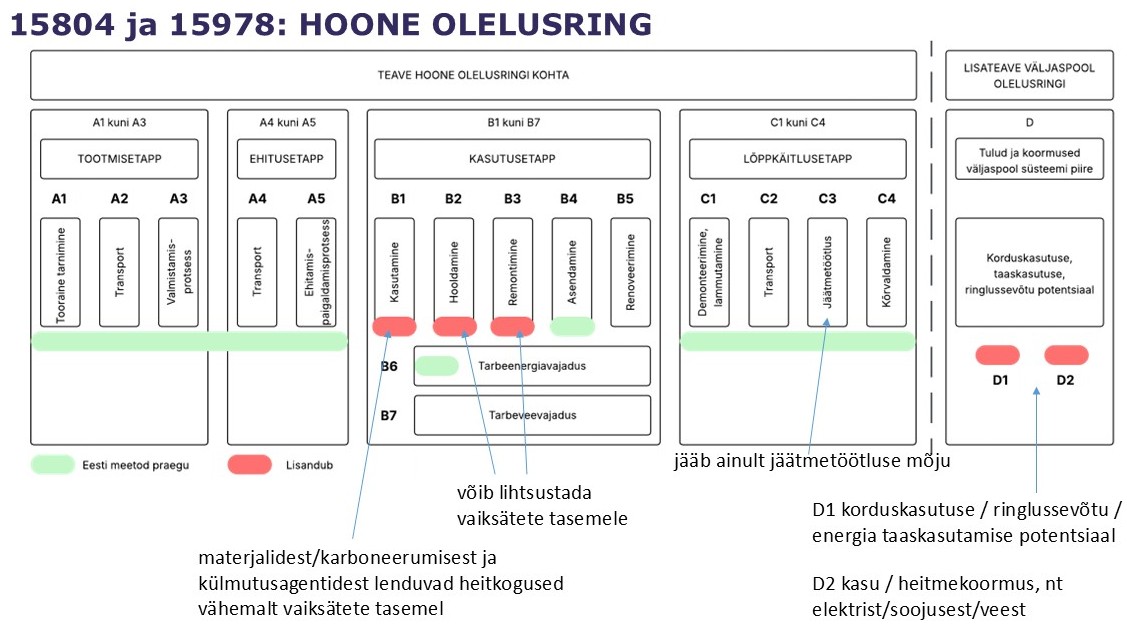
The treatment of life-cycle scenarios has also become more detailed. The old standard described the life-cycle stages and their associated scenarios in general terms. The new standard clearly distinguishes between modules A–C and module D, which lies outside the system boundary. The role of module D has become much more important and is now linked to the treatment of recycling, reuse, and impacts avoided in the future. In addition, the new standard takes future scenarios into account, such as the decarbonization of the energy sector over the building's service life. This means a building is no longer assessed only on the basis of today's situation, but also with regard to conditions that will change in the future.
➡️ The treatment of module D is now much clearer and consistent with EVS-EN 15804+A2, the standard on core product category rules for environmental product declarations of construction products. It should be added here, however, that EN 15804 is currently being updated, and the vote on the prEN15804 revision is scheduled to close on 2026-07-07. In Estonia, no one is aware of this update, since it is a standard within the remit of CEN/TC 350, in whose work we do not participate. As a result, all that remains for us is simply to adopt the new version once it enters into force as an EU standard.
The earlier standard had a separate stage for quantifying the building and its life cycle, in which net quantities, gross quantities, and data volume were determined. The new standard no longer sets this out as a separate stage, since quantification is integrated into the definition of the building model and data requirements. This reflects a shift from manual quantity calculations toward digital models and automated data processing.
➡️ The process becomes more BIM-/LCA data-driven, and less about manual quantity calculations.
The section on environmental indicators has been significantly expanded in the new standard. While the old standard focused mainly on environmental impacts and their calculation methods, the new standard additionally covers resource use and material circularity indicators, biogenic carbon content, carbon sequestration, and other non-LCA-based environmental indicators. Aspects related to the local environment are also introduced. This means that assessing a building's environmental performance no longer means only calculating its CO₂ footprint, but also assessing resource use and circularity.
➡️ The new standard moves from a purely carbon/LCA-based assessment toward a broader assessment of the circular economy and resource use.
An important change also concerns verification and evidencing. The old standard had a general verification stage at the end of the process. In the new standard, this has been replaced by a separate verification system and procedure, followed by reporting. This means that quality control and verification become much more formal, and the assessment results must be more verifiable and comparable.
➡️ Verification and QA/QC become important.
In addition, the new standard separately sets out supplementary information related to end-of-life scenarios. This again underscores the importance of the circular economy, reuse, and module D. The treatment of end of life is no longer a side topic, but has become an essential part of the entire assessment methodology.
➡️ Recycling, reuse, and module D become central themes.
Reporting has also become more detailed and standardized. While the earlier standard required general information, assessment results, and data sources, the new standard requires a separate description of system boundaries, the building model, energy produced and exported, and the communication of results. The aim is to make the results of different projects more comparable and to ensure their usability within the regulatory framework.
➡️ Reporting becomes more standardized and comparable.
In summary, it can be said that EVS-EN 15978:2011 was primarily a classic standard for building LCA assessment, whereas EVS-EN 15978:2026 has developed into a comprehensive environmental performance framework supporting the European Union's climate policy and circular economy objectives. The new standard links building environmental assessment much more closely to EPDs, digital data management, the circular economy, future scenarios, and verified reporting, and makes the entire assessment process considerably more structured and regulatory than before.
With the new standard entering into force, an important terminology translation dilemma is also resolved — is the correct Estonian equivalent for life cycle ’olelusring’ or ’elutsükkel’? Until now, 15978 was the sole basis for using the equivalent ’olelusring’. With the new standard, however, this basis has disappeared, as the translation equivalent ’elutsükkel’ has been chosen instead.
I have also included below an overview of the building's life-cycle modules, showing which modules currently need to be taken into account under the Estonian method and which will be added with the new standard. Given that, in addition, the old standard for assessing the environmental performance of buildings ran to 60 pages, while the new one contains 124 pages of requirements and guidance, perhaps there's no need to spend time updating Estonia's own method after all?