
A new standard is nearing completion that will create a completely renewed understanding, compared to today, of how used products are brought to market. It carries the working title Circular economy – Quality classification for remanufacturing processes. Every time I say that cleaning, repainting, and reusing used windows and doors is extending the lifespan of waste rather than circular economy, a debate begins. That is why I consider the standard currently being developed extremely important, and thanks to my participation in the work of the EVS/TK 83 Circular Economy technical committee, I had the opportunity to review the draft standard.
This is a new European Union circular economy standard that addresses remanufacturing — the remanufacturing of used products — and establishes a single quality classification system for it. The standard does not describe the technical remanufacturing process for an individual product. Rather, it sets out how to assess and communicate remanufacturing quality so that market participants, customers, and legislators use the same concepts and work from the same assumptions.
It should be noted that when translating circular economy standards, we have sometimes used ‘recycling’ as the translation for remanufacturing. With this summary, I hope to lay the groundwork for using the term ‘remanufacturing’ going forward. In my view, ‘remanufacturing’ is the best term, since it best matches both the principle of the circular economy and the substance of the standard now being drafted: a used product is made into a new product that meets the requirements of a new product.
The new standard is being developed in line with the European Union's circular economy policy direction. In particular, the new Construction Products Regulation, the Ecodesign Regulation together with its Digital Product Passport requirement, and Right to Repair initiatives are increasingly making producers responsible for a product's entire life cycle. While current regulations focus mainly on repairability and reuse, this standard creates, for the first time, a system for assessing and demonstrating the quality of full remanufacturing. As such, it could become one of the central standards guiding Europe's industry through the transition to a circular economy.
The premise of the standard is that, within the circular economy, remanufacturing represents the highest-value circular economy strategy. Remanufacturing does not simply restore a used product to working order — instead, a new product is made, reusing existing components to the greatest extent possible. Where necessary, the product is updated with new parts and software, it is tested, and it must meet the same requirements as an equivalent new product. The finished product receives a new identity (for example, a new serial or type number) and is subject to all legislation applicable to new products.
The document emphasizes that remanufacturing is not the same as repair, refurbishment, or reuse, since the aims of these activities are entirely different. The aim of repair is to fix a specific fault and restore the product's functionality. Refurbishment means repairing or updating a used product within the bounds of its original design, in such a way that the product retains its identity. Reuse means using a product again for the same purpose, without extensive recycling. Remanufacturing differs from repair, refurbishment, and reuse in that its output is a new product, which may even be technically better than the original version and whose quality must be comparable to that of a new product.
The standard also describes a typical remanufacturing process, starting with the take-back and sorting of used products, followed by disassembly, component inspection, cleaning, recycling or the addition of new parts where necessary, reassembly, and final testing.
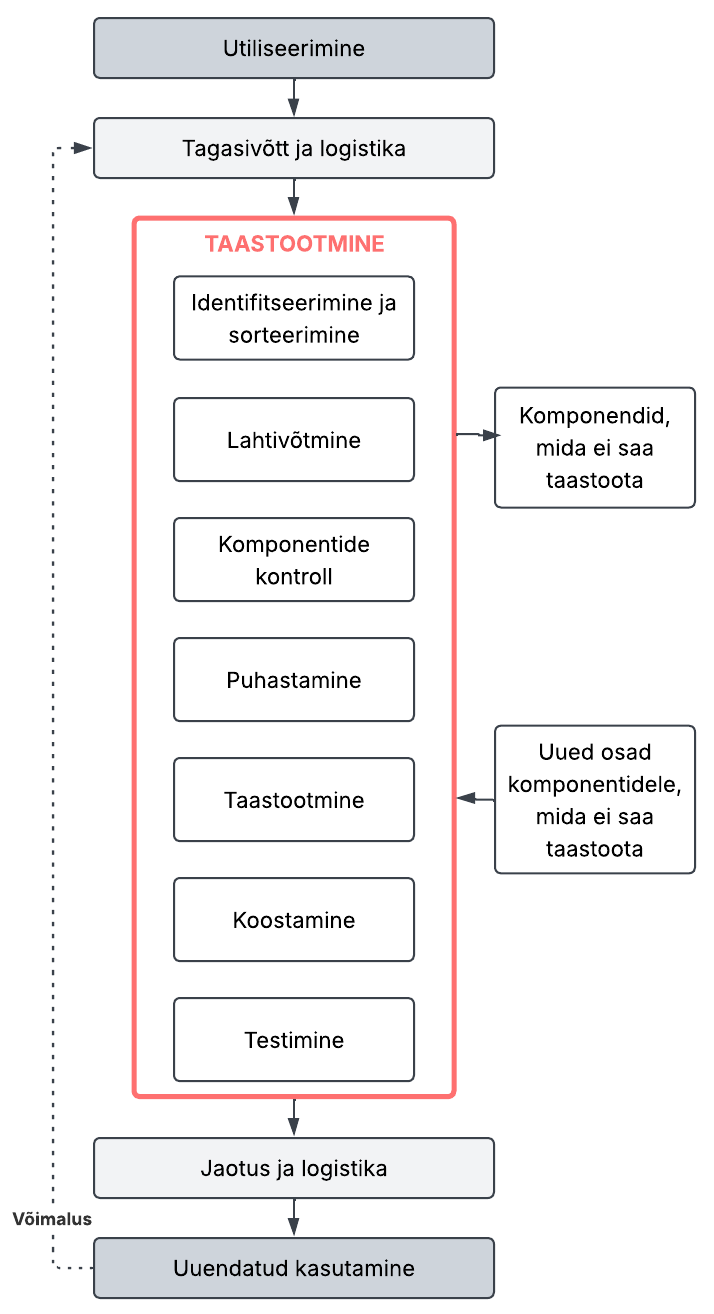 FIGURE: The remanufacturing process diagram shows the full flow, from the return of the used product to the reintroduction of the remanufactured product to the market. It also shows that parts unsuitable for remanufacturing are replaced with new components or sent for recycling.
The standard is being developed because the term ‘remanufacturing’ is given widely differing meanings across different industries. In one context it may mean repair, in another refurbishment, and sometimes even full remanufacturing. As a result, customers do not know what to actually expect from a remanufactured product. Companies are also unable to demonstrate the quality of their products in a comparable way. In addition, unclear concepts create obstacles in legislation and procurement, since there are no consistent criteria for how remanufactured products should be treated.
The new standard creates a quality classification system that makes it possible to objectively assess the level of remanufacturing and communicate product characteristics unambiguously. Customers are directed to assess not the mere fact that a product has been remanufactured, but the quality level to which it has been remanufactured. In the longer term, it is hoped that classification under the standard will remove the need for separate labelling of remanufactured products, since the quality class already provides sufficient clarity about product characteristics. It is also hoped that the standard will help remove legal barriers and support circular economy business models — such as product-as-a-service and recommerce, both highly popular in Estonia as well — for which the trustworthiness of remanufactured products is of critical importance.
The central idea of the standard's working draft is that remanufacturing quality is assessed not on the basis of the finished product, but on the basis of the maturity of the entire remanufacturing process. To achieve this, a three-tier quality classification system is being created, which makes it possible to compare remanufacturing processes carried out by different manufacturers.
The highest level is Class A. This denotes a fully controlled and industrially mature remanufacturing process. Class A level demonstrates that the company has a complete understanding of how the product functions and of its relationship to the entire technical system. It uses thorough technical documentation, all spare parts meet the specifications of new or remanufactured products, a certified quality management system is in place, finished products undergo full functional testing, and staff competence is managed systematically. In essence, Class A means that the quality of the remanufactured product is comparable to that of a new product, and that the entire production process is documented and auditable.
Class B describes a well-functioning process, but one with a somewhat lower level of maturity. The company has thorough knowledge of the product's functions, but not all of its technical knowledge may be fully documented. Testing and quality control are in place, but some activities may rely on the company's experience and existing documentation rather than fully standardized procedures. Quality management is also in place, but its scope and independent verification are not as comprehensive as in Class A.
Class C is the lowest acceptable quality level for remanufacturing. Under Class C, the company has general knowledge of the product being remanufactured, and remanufacturing is carried out mainly on the basis of practical experience and limited documentation. Quality control and testing are in place, but they are not fully formalized, and the quality management system may be simplified. The advantage of Class C is that it allows smaller companies to establish remanufacturing processes as well, but it also indicates that the maturity and verifiability of the process are somewhat lower.
It is important to know that the class does not depend on a single indicator. The standard assesses remanufacturing quality based on the combined effect of several aspects, such as: knowledge of the product and the technical system surrounding it; the ability to give the product a new useful life; the availability of design capacity suited to remanufacturing; principles for the use of new spare parts; the level of the quality management system; and staff qualifications and competence. A process matrix is compiled based on all of these aspects, and it is used to determine the remanufacturing quality class. This means that it is not only the product that is classified, but the entire remanufacturing capability that is assessed.
Understandably, the standard's impact will not be the same across all industries. The greatest value will undoubtedly arise where products have high economic value, a long service life, complex technology, and the potential to be remanufactured multiple times. In such cases, remanufacturing significantly reduces material and energy costs and creates an entirely new business model for the company. The introduction to the standard also emphasizes that remanufacturing is intended primarily for high-value-added products, citing the automotive industry as one of the main areas of application.
In my assessment, the remanufacturing standard is strategically important for Estonian industry. We simply need to look beyond our own noses and abandon the idea that circular economy equals waste management, material recycling, and resource efficiency. Remanufacturing sits considerably higher in the value chain than these activities. Rather than shredding material and turning it back into raw material, as much as possible of the product's added value is preserved — such as its design, components, the energy expended in manufacturing it, and the labor invested in production.
For Estonian companies, this significance may extend across several areas.
The remanufacturing standard affects the machinery and metal industry the most. Estonia produces hydraulic equipment, electrical equipment, automation components, industrial machinery, ventilation equipment, and various mechanical engineering sub-assemblies. Many of these products could, in the future, move toward a business model in which, alongside selling new products or subcontracting services, manufacturers also offer remanufactured equipment and components. This would create an entirely new revenue stream and would likely also help retain existing customers.
Another important area is equipment modernization. Several companies in Estonia are already upgrading industrial equipment or rebuilding existing machinery. At present, this is usually called modernization, retrofitting, or refurbishment. The new standard will help define when such activity already qualifies as remanufacturing, and which quality requirements must then be met.
Third, the standard affects Estonian companies that supply components to international manufacturers. Larger European OEMs are being directed to organize their remanufacturing processes according to this standard, and they will very likely start expecting the same from their suppliers. This means the standard could become a supply-chain requirement even for companies that do not remanufacture the final product themselves.
A significant impact may also arise in the construction sector. Although this is not directly a standard for the circularity of construction products, European construction is increasingly moving toward the reuse and remanufacturing of building components. For example, ventilation equipment, elevators, electrical equipment, pumps, lighting, and other technical systems could, in the future, fall under the remanufacturing model. The standard could also be significant for the defense industry. Estonia's defense industry is growing rapidly, and extending the life cycle of vehicles, electronics, and other equipment is becoming increasingly important. Internationally, remanufacturing is already common practice specifically in the defense industry.
Estonia has been an active adopter of the ISO 59000 circular economy standards. The remanufacturing standard complements them with practical industrial application. While ISO 59004, ISO 59010, and ISO 59020 provided the general principles and metrics of the circular economy, the EU remanufacturing standard now being developed describes, in very concrete terms, how to implement higher-value circular economy practices in production and how to demonstrate the quality of remanufactured products.