The European Union is moving toward a circular economy, which is giving rise to new requirements for companies to disclose data on the composition, service life, and recyclability of their products. The form of disclosure is the digital product passport (Digital Product Passport, acronym DPP), and we have previously published an overview of the sectors in which the digital product passport requirement must be taken into account Ready to Receive the Digital Product Passport. It should be noted that the digital passport for batteries and accumulators will be mandatory from 2027, and the digital passport register will open on 19 June 2026.
It would be wrong to assume that we don't know what data must be disclosed in a product's digital passport. We know very well, and the relevant standard has already been adopted in Estonia. It is EVS-ISO 59040:2025 Circular economy. Product circularity data sheet. We are keeping our fingers crossed that EVS will succeed in securing funding to translate this standard. It is the most important standard in the circular economy, because it alone specifies how companies document and demonstrate the circular economy properties of their products. The only thing we don't yet know at this point is the sector-specific threshold values.
And now, please forget for a moment the buzzwords ‘circular design’ and ‘modularity.’ These are two completely different topics. Just as waste management and the circular economy are entirely different topics, circular design and product circularity are also entirely different topics. Why? The European Union has not built any regulation around how circularly someone has designed their product. Instead, the Ecodesign for Sustainable Products (ESPR) framework is building a system in which a company must be able to substantiate, measure, and digitally share its claims. The limitation of the circular design and modularity concept lies in the fact that it focuses on product properties rather than on proving those properties. Reducing waste and reusing materials are important, but this is just one of many possible activities supporting the development of the circular economy. The most important thing, however, is the availability of reliable information about products. Today, companies use a variety of environmental declarations, certificates, and reports, but their content and structure often differ. This makes it harder to compare products and increases the administrative burden for both manufacturers and customers.
EVS-ISO 59040:2025 creates a unified framework through which the entire supply chain can exchange standardized information about the circular economy properties of products. The standard describes the product circularity data sheet, which contains verifiable and comparable information about a product's composition, the origin of materials, repairability, recyclability, and other circularity-related properties. The standard is based on the understanding that today's linear economic model — extract, produce, use, and discard — is not sustainable. The goal of the circular economy is to keep resources in use for as long as possible and to preserve their value throughout the entire life cycle. The product circularity data sheet helps make the achievement of this goal visible and verifiable.
The product circularity data sheet (Product Circularity Data Sheet, acronym PCDS) is essentially a standardized declaration that contains information about a product's circular economy properties. Unlike conventional descriptive reports, the PCDS is based on verifiable claims presented in true-or-false form. This approach helps reduce room for interpretation and makes the data machine-readable and suitable for automated processing. The standard emphasizes that every claim must be verifiable and, where necessary, linked to supporting documentation that can be referenced through persistent identifiers.
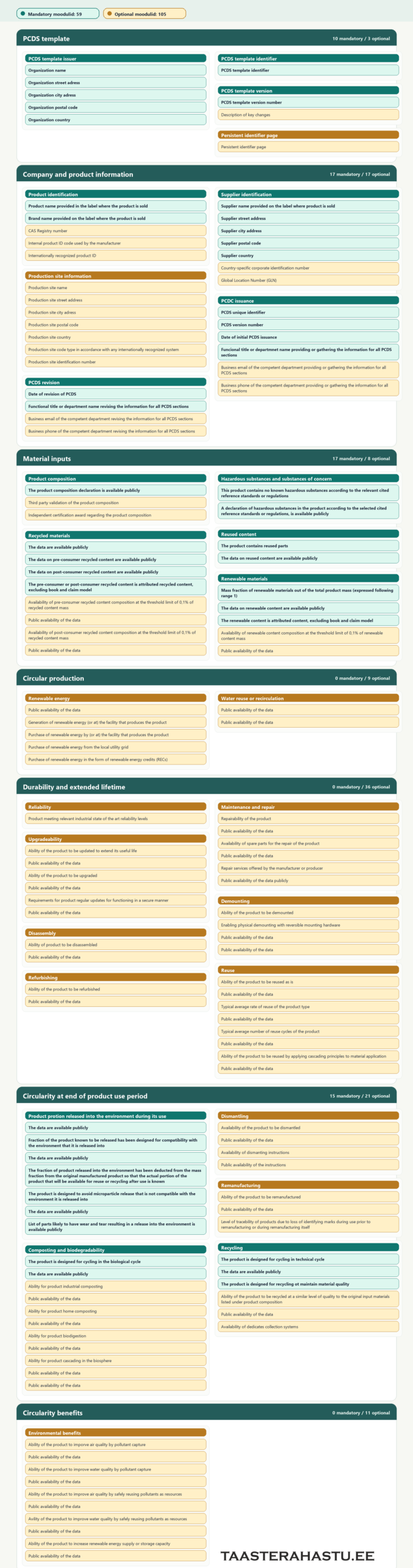
The PCDS covers a product's entire life cycle. The data sheet first presents information about the product, the manufacturer, and the production site. It then focuses on materials and composition. It describes which materials the product consists of, which chemicals it contains, and whether the product contains any hazardous substances. Attention is also paid to what proportion of the product contains recycled or reused materials, and whether the renewable materials used originate from sustainable sources. An important part of the standard also addresses the production process. Companies can describe their use of renewable energy in production, as well as water reuse or recirculation solutions. Although these topics are not mandatory in every sector, they are considered an important indicator of circular economy performance. The standard allows all data to be presented in a unified format, thereby providing a common, agreed basis for comparing different products and manufacturers.
Special attention is paid to the product's service life. From a circular economy perspective, it is not only the materials used that matter, but also the product's service life. That is why the PCDS includes information on maintainability, repairability, upgradability, and disassemblability. It can also describe whether the product can be reused or refurbished after use. These properties directly affect the product's actual environmental impact and help reduce the need for new materials.
The end-of-life stage of the product is also addressed thoroughly in the standard. The data sheet allows information to be provided on whether the product can be recycled, remanufactured, or composted, and whether materials or particles are released into the environment during use. Such information is becoming increasingly important both for waste management organizers and for companies wishing to demonstrate the circular economy performance of their products.
In addition to technical data, EVS-ISO 59040:2025 also addresses governance and conformity assessment. The standard provides guidance on how buyers and suppliers should use the PCDS, what risks should be taken into account when sharing data, and how to organize change management and auditing. The aim is to ensure that the data presented is reliable and that its quality can, if necessary, be verified by an independent party.
Although EVS-ISO 59040:2025 does not directly address the digital product passport, the connection between the two concepts is evident. The European Union's forthcoming digital product passport requirements presuppose that structured, machine-readable, and reliable data on products will be available. EVS-ISO 59040:2025 was created precisely to describe such a data set. Many experts therefore see the PCDS as one possible foundational structure on which future digital product passports could be built.
Companies will therefore need to start collecting increasingly detailed information about the materials used in a product, its composition, recycled content, repairability, and recyclability. This, in turn, increases the need for life-cycle assessments, environmental declarations, material declarations, and supply chain data. In Estonia, this primarily affects manufacturers of construction materials, furniture, and electronic products. It is precisely these manufacturers whose requirements — arising from both customers and regulations — will increase significantly in the coming years.
EVS-ISO 59040:2025 clearly shows that the next stage in the development of the circular economy no longer consists solely of material reuse, but of the standardization of information about product circularity. Companies that can provide high-quality, verifiable data about their products will gain a significant competitive advantage in the future, both in public procurement and in international markets.
Below is an overview of the mandatory and voluntary data subject to disclosure (standard EVS-ISO 59040:2025 Circular economy. Product circularity data sheet):